
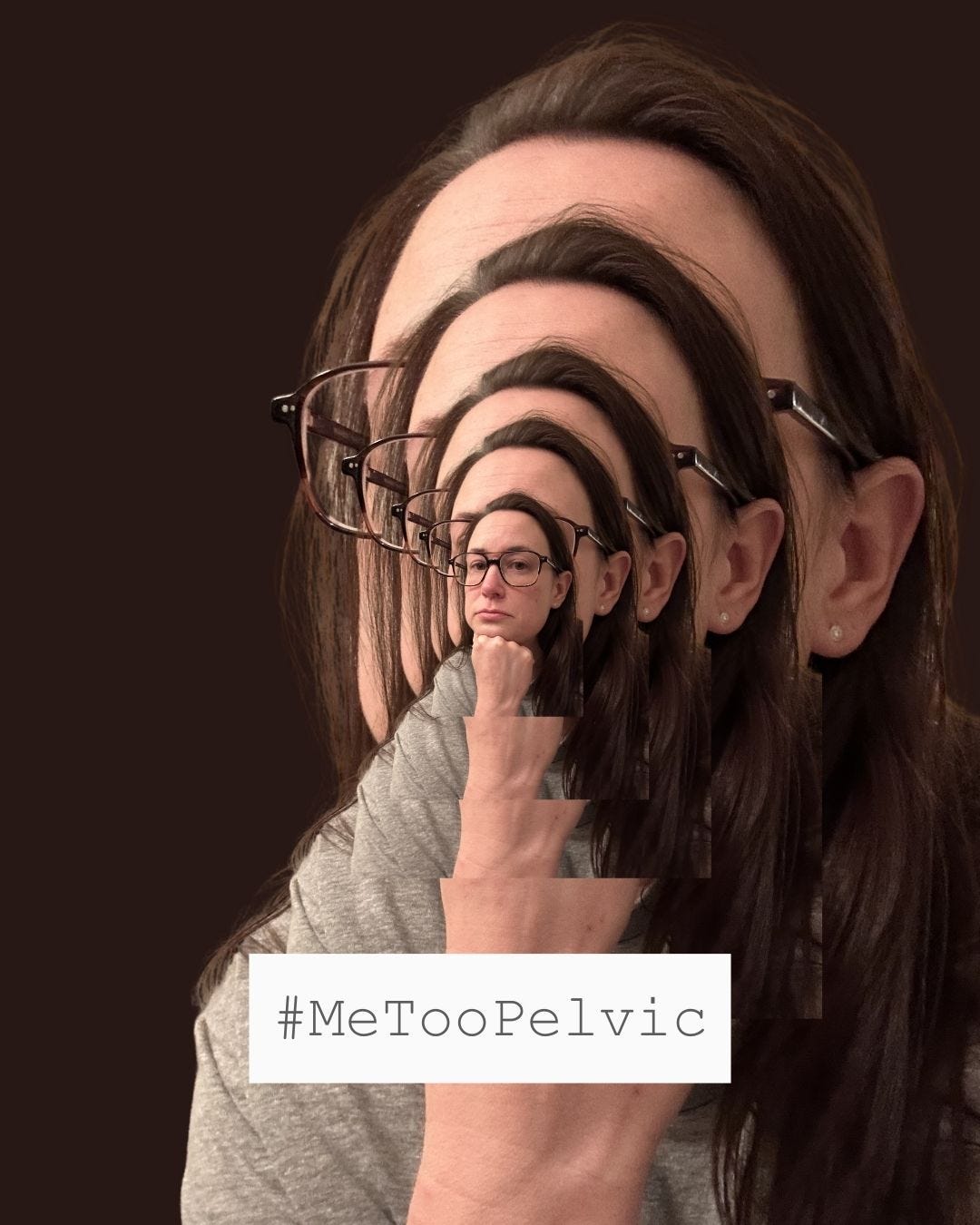
#MeTooPelvic
Content notice: sexual assault, unconsented pelvic examination
I began teaching trauma-informed pelvic care in 2018. Over the years, working with midwives, physicians, nurse practitioners, and learners to understand how best to integrate this framework into practice has been a powerful - and often frustrating - experience. There are so many moving responses, including from providers whose experiences mirror those of patients, providers absorbing the impact of unintended actions, and providers who become changemakers in their workplaces. More often than not, however, there are dismissive responses around every corner, based on time, or presumed patient safety, or professional authority of knowing what is best for the patient. These negatives are tried-and-true scripts that uphold the system that harms people. I know the traditional medical industrial complex well, having worked within the system for nearly a decade. I know that entrenched systems of physician and provider power diminish the embodied knowledge of patients, so a model like trauma-informed care, born from and strengthened by sexual assault survivors, has always had an uphill climb.
I knew all of this so well that I also knew I had to leave the system in which I worked to gain more knowledge, to be able to argue better and differently, to achieve a terminal degree to go toe-to-toe with others who had the same. After ten years as a Nurse-Midwife, a Fellowship in Clinical Medical Ethics, and defending my PhD in Health Care Ethics focused on “Consent in Pelvic Care” in November of last year, I have been calmly embracing a new level of knowledge and confidence in this work. My writing and activism have been building toward this moment.
In January, I restarted pelvic floor physical therapy. The clinic sent me a questionnaire beforehand, with questions about my symptoms, previous pelvic floor physical therapy experience, and my concerns. I completed all the questions, including one about a history of sexual assault, which I checked, “yes.”
As the visit started, I became concerned that my questionnaire had not been reviewed beforehand. She not only asked questions I had already answered, but the answers I then found myself giving in real time seemed to be brand new information. Having been on the question-asking side of these interactions, I know that sometimes clinicians ask the same questions as those listed in a pre-visit survey to be sure of the answers or to ask follow-up questions. This discussion did not fit that flow. As I answered, she responded, “Oh,” multiple times, and it was clear that my responses interrupted what she thought might be a more straightforward visit. In the course of the intake, she did not ask about a history of sexual assault. I did not bring it up.
I cried throughout the discussion. Honestly, sobbing might be a better descriptor. Surprisingly, even to me at times, I am still very, very sad about having needed a hysterectomy. And perhaps I am even sadder about still needing visits related to it, given the continued sequelae. In realizing that I had done so much emotional and logistical work to prepare for this visit, including disclosing my history on the form, only to have that time and honesty missed was additionally sad. I found myself struggling to answer questions while struggling to control my crying and breathing. She kept on asking questions and moving the visit forward. Eventually, she asked why I was crying, and I said I was sad about the hysterectomy and that the first round of pelvic floor physical therapy was not helpful. She told me to undress.
I undressed and lay on the examination table. Knees bent, feet hip distance apart and flat on the table, she touched and then entered my body without saying anything at all. It was all that fast and that quiet.
I could not believe how quickly it happened. I resumed crying, this time silently. She asked me to differentiate between pain and pressure at many points around and at many points deep. I continued crying. There were areas that I knew immediately were clearly painful, while others felt tight or numb. I said, “I don’t know, it feels difficult to tell pain from pressure right now,” and upon hearing my own voice, I choked back crying harder. Her language was not working for me, but I could not find my own language. I continued crying. At one point she asked me what I do. I said I was a midwife and just finished my PhD. “In what?” “Health care ethics.” No further questions, and I chose not to elaborate. I continued crying. Suddenly, without warning, she removed her fingers, and the examination ended. I stopped crying.
In midwifery, our examining fingers and hand may be inside someone during emergencies and other incredibly stressful situations. It is often difficult to complete an examination or provide care while someone is crying, because the pelvic floor muscles are part of that bodily response and affect the patient’s and provider’s ability to communicate let alone conduct the examination. It is certainly difficult to determine which areas hurt or are injured. I know what it feels like to be inside someone’s body while they are crying. You can feel it.
So to know that she could see me crying, hear me crying, and feel me crying, and the examination continued, was another layer of sadness.
Amid everything, to be asked about my work was… I don’t have words for it. During an unconsented examination, while I am having a trauma activation response based on my own previous history of sexual assault and health care trauma, to then speak aloud words that describe my work on consent and pelvic care, my work on unethical examinations and medical sexual assault, my work on trauma-informed care and clinical rape culture, would have shattered me. I also know that having stayed quiet shattered me in different ways.
I do this work for survivors. I do this work for me.
#MeToo Pelvic entered the social media lexicon shortly after #MeToo and #TimesUp. Just as people shared forceful sexual assaults alongside under-consented or confusing sexual interactions, patients began sharing parallel experiences during pelvic examinations. Obstetric violence has a longer history of developing language around force, harm, and assault in pregnancy and birth settings, whereas this research and language are still nascent for pelvic examinations. Assaults by Larry Nassar and Robert Hadden have opened the doors to understanding how shrouds around what happens during pelvic care ultimately harm patients and generate crimes of opportunity for assailants, but there is so much more to be done to understand the nuances of ethical consent for pelvic examinations when one is otherwise consenting-to healthcare. Here is an excerpt from my dissertation in which I write broadly about the language we use during pelvic care to describe what we are doing in line with ethical standards, as well as to be transparent about the components of the examination itself.
The ongoing #MeToo movement highlights longstanding and ongoing concepts of bodily sovereignty and sexual boundaries that seek to improve public and private understandings of intimate safety and harm. One result of #MeToo in genital healthcare examinations came through the sharing on social media of #MeTooPelvic, a way of connecting stories of assault through unconsented vaginal examinations with the adjoining #JustAsk conveying patients’ pleas for adequate consent.[1] While the connections between these two hashtags initially reference unconsented or under-consented educational pelvic examinations under anesthesia, patients’ accounts expanded into lack of consent in other types of genital care that led to intimate harms. In reading these threads – from my own intersecting identities as a survivor, patient, and clinician – and affirming the patient’s stories and experiences based on my own, I found that at times there seemed to be a lack of clarity in both the consent process - including ethical misinterpretations of consent on the part of the provider, as in the case for presumed consent to pelvic examinations under anesthesia – and what exactly the patient was consenting to.[2]
In this pelvic floor physical therapy visit, the provider could have reasonably assumed that, as a midwife and someone who had been to pelvic floor physical therapy before, I understood what the day’s examination would entail. That would have been true, but the presumption’s premise is irrelevant. I am a person, meeting them for the first time, receiving an examination from them for the first time, sobbing, and unable to provide necessary feedback about my own pain due to my distress. I am a patient who needs to give consent, both initial and ongoing. Any person deserves to be told before someone touches them, before someone enters their body, and attended to when crying while someone is inside their body.
In trauma-informed care work, I often talk about what information a provider can garner about someone’s potential traumatic history, regardless of whether that person chooses to disclose. Many components of my own healthcare record would have been easy to puzzle together: gender, sexuality, mental health history. But then again, I did disclose. And I was crying and sobbing and in distress and unable to answer “pain” versus “pressure,” which was the entire point of the examination I experienced during which I was activated in previous trauma and retraumatized, and that makes the entire exam worthless, clinically speaking, and worthless to me because I will not ever return to see that provider.
And this, of course, is why trauma-informed care exists. This is why survivors spoke up in the 90s to voice why traditional healthcare was harmful. This model of providers having access to any and all of a patient’s body, that the patient’s social response or physiologic response or verbal response is a distraction or a hindrance or irrelevant to the delivery of care, that penetrative examinations are the norm and not the exception, that consent is assumed unless a verbal (what type of verbiage?), clear (how clear?), loud (how loud?), “No.” interrupts the assumption, harms people. It harmed me, not only in activating my own trauma and generating a new traumatic experience, but also in causing a deeper hurt and a broader reckoning for why I need to keep writing, to keep teaching, to keep advocating for ethical consent practices and trauma-informed care.
I do this work for survivors. I do this work for me. #MeTooPelvic
Stephanie
[1] With increased censoring and decreasing use of Twitter, where these hashtags were most often used, many of these linked disclosures have been lost. For more on these linkages, see: Friesen, Phoebe. “Educational Pelvic Exams on Anesthetized Women: Why Consent Matters.” Bioethics 32, no. 5 (2018): 298–307. https://doi.org/10.1111/bioe.12441. Wilson, Robin Fretwell, and Anthony Michael Kreis. “#JustAsk: Stop Treating Unconscious Female Patients like Cadavers.” Chicago Tribune, November 29, 2018. https://www.chicagotribune.com/opinion/commentary/ct-perspec-pelvic-nonconsensual-exam-medical-students-vagina-medical-1203-story.html.
[2] Summarized here for brevity. I elaborate on the connections between #MeToo, #MeTooPelvic, and #JustAsk in a recent paper conceptualizing why unconsented genital examinations qualify as sexual assault: Tillman, Stephanie. “Presumed Consent for Pelvic Exams Under Anesthesia Is Medical Sexual Assault.” IJFAB: International Journal of Feminist Approaches to Bioethics 16, no. 1 (April 1, 2023): 1–20. https://doi.org/10.3138/ijfab-2022-0002.
Stephanie.
I can't say 'thank you' for sharing this, because that feels odd.
What I actually mean is, I see you sharing this, and appreciate what you are sharing and the context it is shared in. It brought back many moments with patients sharing their own stories of similar experience and all the points of consent around those moments. It also brought up what I have navigated as a patient. Not as a trigger. But as a reminder to continue, with you and others, the important work around this.
I am sorry this happened to you and grateful that you are speaking out about this. The work you’re doing is important and helps so many people. I learn so much from your posts and